Wazuh to OpenCTI Integration
This post is how to set up integration between Wazuh and OpenCTI
Introduction
This guide walks you through integrating Wazuh, an open-source SIEM and XDR platform, with OpenCTI, a leading open-source threat intelligence platform. The result is a bidirectional integration that automatically detects indicators of compromise (IOCs) and enriches your security alerts with actionable threat context.
Why This Integration Matters
The Problem with Traditional Security Operations
Security teams face several critical challenges:
Alert Fatigue: SOC analysts review thousands of alerts daily, most of which are benign. Without context, it’s nearly impossible to identify real threats quickly.
Intelligence Silos: Threat intelligence platforms collect vast amounts of IOC data, but this information rarely makes it to the tools that need it most—your SIEM and detection systems.
Manual Correlation: Analysts waste precious time manually checking if observed IPs, domains, or file hashes are malicious, looking them up in VirusTotal, threat feeds, or internal databases.
Delayed Response: By the time threats are identified and correlated with intelligence, attackers may have already achieved their objectives.
How Wazuh + OpenCTI Solves These Problems
This integration creates an automated threat intelligence pipeline:
- Proactive Detection: OpenCTI’s threat intelligence automatically feeds into Wazuh, enabling real-time detection of known malicious IPs, domains, file hashes, and URLs
- Automatic Enrichment: When Wazuh detects an IOC, it queries OpenCTI for additional context—threat actor associations, campaign information, and confidence scores
- Bidirectional Intelligence: Detection events in Wazuh create “sightings” in OpenCTI, showing where and when threats appear in your environment
- Contextual Alerting: Security teams receive enriched alerts with full threat context, enabling faster, more informed responses
Architecture Overview
The integration works in two complementary directions:
- OpenCTI → Wazuh (Proactive Detection)
1
2
3
4
5
6
7
8
9
OpenCTI Threat Intelligence
         ↓
   [Sync Script runs every 6 hours]
         ↓
   Wazuh CDB Lists (IOCs)
         ↓
   Detection Rules
         ↓
   Alerts when matches found
How it works: A Python script periodically pulls indicators from OpenCTI and creates CDB (Constant Database) lists that Wazuh uses for real-time log correlation. When any log entry matches an IOC, Wazuh immediately generates an alert.
- Wazuh → OpenCTI (Enrichment & Sightings)
1
2
3
4
5
6
7
8
9
Wazuh Alert Generated
         ↓
   [Integration Script]
         ↓
   Query OpenCTI for context
         ↓
   Create Sighting in OpenCTI
         ↓
   Return Enriched Alert
How it works: When Wazuh generates an alert (especially IOC matches), an integration script queries OpenCTI’s API for additional context and creates a “sighting” record showing when and where the indicator was observed.
Prerequisites
- Wazuh Manager installed and running
- OpenCTI instance accessible from Wazuh Manager
- OpenCTI API token with write permissions
- Python 3.6+ installed on Wazuh Manager
Part 1: Setting Up OpenCTI to Wazuh IOC Feed
This component proactively feeds threat intelligence from OpenCTI into Wazuh for detection.
Step 1: Install Dependencies: Install Python Dependencies (I installed this on the system for testing my scripts)
1
pip3 install pycti requests
Install pycti so that Wazuh Manager can use the package
1
/var/ossec/framework/python/bin/python3 -m pip install pycti
Step 2: Create the custom Integration
Create a file /var/ossec/integrations/custom-opencti. All custom integrations must be prepended with custom-* for Wazuh.
1
vim /var/ossec/integrations/custom-opencti
Paste in the file contents:
1
2
3
4
5
6
7
8
9
10
11
12
13
14
15
16
17
18
19
20
21
22
23
24
25
26
27
28
29
30
31
32
33
34
35
36
37
38
#!/bin/sh
# Copyright (C) 2015, Wazuh Inc.
# Created by Wazuh, Inc. <[email protected]>.
# This program is free software; you can redistribute it and/or modify it under the terms of GPLv2

WPYTHON_BIN="framework/python/bin/python3"

SCRIPT_PATH_NAME="$0"

DIR_NAME="$(cd $(dirname ${SCRIPT_PATH_NAME}); pwd -P)"
SCRIPT_NAME="$(basename ${SCRIPT_PATH_NAME})"

case ${DIR_NAME} in
    */active-response/bin | */wodles*)
        if [ -z "${WAZUH_PATH}" ]; then
            WAZUH_PATH="$(cd ${DIR_NAME}/../..; pwd)"
        fi

        PYTHON_SCRIPT="${DIR_NAME}/${SCRIPT_NAME}.py"
    ;;
    */bin)
        if [ -z "${WAZUH_PATH}" ]; then
            WAZUH_PATH="$(cd ${DIR_NAME}/..; pwd)"
        fi

        PYTHON_SCRIPT="${WAZUH_PATH}/framework/scripts/$(echo ${SCRIPT_NAME} | sed 's/\-/_/g').py"
    ;;
     */integrations)
        if [ -z "${WAZUH_PATH}" ]; then
            WAZUH_PATH="$(cd ${DIR_NAME}/..; pwd)"
        fi

        PYTHON_SCRIPT="${DIR_NAME}/${SCRIPT_NAME}.py"
    ;;
esac


${WAZUH_PATH}/${WPYTHON_BIN} ${PYTHON_SCRIPT} "$@"
Set the proper permissions
1
2
sudo chmod 750 /var/ossec/integrations/custom-opencti
sudo chown root:wazuh /var/ossec/integrations/opencti
Step 3. Configure the Python script for the integration
Create the /var/ossec/integrations/custom-opencti.py file
This script:
- Receives alerts from Wazuh
- Extracts IOCs (IPs, hashes, domains)
- Queries OpenCTI for matches
- Creates sightings in OpenCTI
- Returns enriched alerts
Paste in the contents
1
2
3
4
5
6
7
8
9
10
11
12
13
14
15
16
17
18
19
20
21
22
23
24
25
26
27
28
29
30
31
32
33
34
35
36
37
38
39
40
41
42
43
44
45
46
47
48
49
50
51
52
53
54
55
56
57
58
59
60
61
62
63
64
65
66
67
68
69
70
71
72
73
74
75
76
77
78
79
80
81
82
83
84
85
86
87
88
89
90
91
92
93
94
95
96
97
98
99
100
101
102
103
104
105
106
107
108
109
110
111
112
113
114
115
116
117
118
119
120
121
122
123
124
125
126
127
128
129
130
131
132
133
134
135
136
137
138
139
140
141
142
143
144
145
146
147
148
149
150
151
152
153
154
155
156
157
158
159
160
161
162
163
164
165
166
167
168
169
170
171
172
173
174
175
176
177
178
179
180
181
182
183
184
185
186
187
188
189
190
191
192
193
194
195
196
197
198
199
200
201
202
203
204
205
206
207
208
209
210
211
212
213
214
215
216
217
218
219
220
221
222
223
224
225
226
227
228
229
230
231
232
233
234
235
236
237
238
239
240
241
242
243
244
245
246
247
248
249
250
251
252
253
254
255
256
257
258
259
260
261
262
263
264
265
266
267
268
269
270
271
272
273
274
275
276
277
278
279
280
281
282
283
284
285
286
287
288
289
290
291
292
293
294
295
296
297
298
299
300
301
302
303
304
305
306
307
308
309
310
311
312
313
314
315
316
317
318
319
320
321
322
323
324
325
326
327
328
329
330
331
332
333
334
335
336
337
338
339
340
#!/usr/bin/env python3
"""
Wazuh-OpenCTI Integration Script
Queries OpenCTI for IOC matches and creates sightings when found
Place in: /var/ossec/integrations/custom-opencti.py
"""

import sys
import json
import os
import logging
from datetime import datetime, timezone
from pycti import OpenCTIApiClient
from datetime import datetime, timezone

now = datetime.now(timezone.utc)
timestamp = now.isoformat(timespec='milliseconds').replace('+00:00', 'Z')

# Configuration
OPENCTI_URL = '<opencti ip or url>'
OPENCTI_TOKEN = '<opencti token>'
LOG_FILE = '/var/ossec/logs/opencti-integration.log'

# Setup logging
logging.basicConfig(
    filename=LOG_FILE,
    level=logging.INFO,
    format='%(asctime)s - %(levelname)s - %(message)s'
)

class WazuhOpenCTIIntegration:
    def __init__(self):
        """Initialize OpenCTI API client"""
        try:
            self.client = OpenCTIApiClient(OPENCTI_URL, OPENCTI_TOKEN)
            self.wazuh_identity_id = None  # Cache the identity ID
            logging.info("Successfully connected to OpenCTI")
        except Exception as e:
            logging.error(f"Failed to connect to OpenCTI: {e}")
            sys.exit(1)
    def get_or_create_agent_identity(self, agent_name, agent_ip):
        """
        Create or return a STIX Identity for the specific agent.
        """
        try:
            # Try to find existing identity by name
            identities = self.client.identity.list(
                filters={
                    "mode": "and",
                    "filters": [{
                        "key": ["name"],
                        "values": [agent_name],
                        "operator": "eq"
                    }],
                    "filterGroups": []
                }
            )
            if identities and len(identities) > 0:
                return identities[0]['id']

            # Create identity if not found
            identity = self.client.identity.create(
                type="System",
                name=agent_name,
                description=f"Wazuh Agent at {agent_ip}"
            )
            return identity['id']

        except Exception as e:
            logging.error(f"Error creating agent identity for {agent_name}: {e}")
            return None

    def get_or_create_wazuh_identity(self):
        """Get or create a Wazuh identity to use as the sighting source"""
        # Return cached ID if we already have it
        if self.wazuh_identity_id:
            return self.wazuh_identity_id

        try:
            # Try to find existing Wazuh identity
            identities = self.client.identity.list(
                filters={
                    "mode": "and",
                    "filters": [{
                        "key": ["name"],
                        "values": ["Wazuh SIEM"],
                        "operator": "eq"
                    }],
                    "filterGroups": []
                }
            )

            if identities and len(identities) > 0:
                self.wazuh_identity_id = identities[0]['id']
                logging.info(f"Found existing Wazuh identity: {self.wazuh_identity_id}")
                return self.wazuh_identity_id

            # Create new identity if not found
            identity = self.client.identity.create(
                type="System",
                name="Wazuh SIEM",
                description="Wazuh Security Information and Event Management System"
            )

            self.wazuh_identity_id = identity['id']
            logging.info(f"Created Wazuh identity: {self.wazuh_identity_id}")
            return self.wazuh_identity_id

        except Exception as e:
            logging.error(f"Error getting/creating Wazuh identity: {e}")
            return None

    def extract_iocs(self, alert):
        """Extract potential IOCs from Wazuh alert"""
        iocs = {
            'ipv4': [],
            'ipv6': [],
            'domain': [],
            'url': [],
            'file_hash': []
        }

        data = alert.get('data', {})

        # Extract IPs
        if 'srcip' in data:
            iocs['ipv4'].append(data['srcip'])
        if 'dstip' in data:
            iocs['ipv4'].append(data['dstip'])

        # Extract file hashes
        for hash_type in ['md5', 'sha1', 'sha256']:
            if hash_type in data:
                iocs['file_hash'].append({
                    'type': hash_type,
                    'value': data[hash_type]
                })

        # Extract domains and URLs
        if 'url' in data:
            iocs['url'].append(data['url'])
        if 'domain' in data:
            iocs['domain'].append(data['domain'])
        if 'dns_query' in data:
            iocs['domain'].append(data['dns_query'])

        return iocs

    def search_indicator(self, ioc_type, ioc_value):
        """Search for indicator in OpenCTI"""
        try:
            # Build STIX pattern based on IOC type
            if ioc_type == 'ipv4':
                pattern = f"[ipv4-addr:value = '{ioc_value}']"
            elif ioc_type == 'ipv6':
                pattern = f"[ipv6-addr:value = '{ioc_value}']"
            elif ioc_type == 'domain':
                pattern = f"[domain-name:value = '{ioc_value}']"
            elif ioc_type == 'url':
                pattern = f"[url:value = '{ioc_value}']"
            elif ioc_type == 'file_hash':
                hash_type = ioc_value['type'].upper()
                pattern = f"[file:hashes.'{hash_type}' = '{ioc_value['value']}']"
                ioc_value = ioc_value['value']
            else:
                return None

            # Search for indicators matching the pattern
            indicators = self.client.indicator.list(
                filters={
                    "mode": "and",
                    "filters": [{
                        "key": ["pattern"],
                        "values": [pattern],
                        "operator": "eq"
                    }],
                    "filterGroups": []
                }
            )

            if indicators:
                logging.info(f"Found match for {ioc_type}: {ioc_value}")
                return indicators[0] if isinstance(indicators, list) else indicators

            return None

        except Exception as e:
            logging.error(f"Error searching for {ioc_type} {ioc_value}: {e}")
            return None

    def create_sighting(self, indicator_id, alert):
        """Create a sighting in OpenCTI"""
        try:
            # Get Wazuh identity to use as sighting source
            wazuh_identity_id = self.get_or_create_wazuh_identity()
            if not wazuh_identity_id:
                logging.error("Could not get Wazuh identity, cannot create sighting")
                return None

            # Extract relevant information from Wazuh alert
            agent_name = alert.get('agent', {}).get('name', 'Unknown')
            agent_ip = alert.get('agent', {}).get('ip', 'Unknown')
            rule_description = alert.get('rule', {}).get('description', 'Wazuh Alert')
            rule_id = alert.get('rule', {}).get('id', 'Unknown')
            #timestamp = alert.get('timestamp', datetime.now(timezone.utc))
            raw_ts = alert.get('timestamp')
            if raw_ts:
            # parse the alert timestamp, convert to UTC
                try:
                    dt = datetime.fromisoformat(raw_ts)
                    if dt.tzinfo is None:
                        dt = dt.replace(tzinfo=timezone.utc)
                    else:
                        dt = dt.astimezone(timezone.utc)
                except Exception:
                    dt = datetime.now(timezone.utc)
            else:
                dt = datetime.now(timezone.utc)

            timestamp_str = dt.isoformat(timespec='milliseconds').replace('+00:00', 'Z')

            # Create/get agent identity for this alert
            agent_identity_id = self.get_or_create_agent_identity(agent_name, agent_ip)

            # Create sighting description
            description = (
                f"Detected by Wazuh on agent {agent_name} ({agent_ip}). "
                f"Rule {rule_id}: {rule_description}"
            )

            # Create the sighting using stix_sighting_relationship
            sighting = self.client.stix_sighting_relationship.create(
                toId=agent_identity_id,  # The entity that saw the indicator (Wazuh)
                fromId=indicator_id,          # The indicator that was seen
                description=description,
                first_seen=timestamp_str,
                last_seen=timestamp_str,
                count=1,
                confidence=75
            )

            logging.info(f"Created sighting for indicator {indicator_id}")
            return sighting

        except Exception as e:
            logging.error(f"Error creating sighting: {e}")
            return None

    def generate_wazuh_alert(self, indicator, alert):
        """Generate enriched Wazuh alert with OpenCTI data"""
        try:
            # Safely extract labels
            labels = indicator.get('objectLabel', [])
            if labels and isinstance(labels, list):
                label_values = [label.get('value', '') for label in labels if isinstance(label, dict)]
            else:
                label_values = []

            # Safely extract created by
            created_by = indicator.get('createdBy', {})
            threat_actor = created_by.get('name', 'Unknown') if isinstance(created_by, dict) else 'Unknown'

            enriched_alert = {
                "opencti_match": True,
                "indicator_id": indicator.get('id'),
                "indicator_name": indicator.get('name'),
                "indicator_labels": label_values,
                "indicator_score": indicator.get('x_opencti_score', 0),
                "threat_actor": threat_actor,
                "original_alert": {
                    "rule_id": alert.get('rule', {}).get('id'),
                    "rule_description": alert.get('rule', {}).get('description'),
                    "agent_name": alert.get('agent', {}).get('name'),
                    "agent_ip": alert.get('agent', {}).get('ip')
                }
            }

            # Write enriched alert to stdout (Wazuh will capture this)
            print(json.dumps(enriched_alert))

            return enriched_alert
        except Exception as e:
            logging.error(f"Error generating enriched alert: {e}")
            return None

    def process_alert(self, alert):
        """Main processing function"""
        try:
            rule_id = alert.get('rule', {}).get('id', 'Unknown')
            logging.info(f"Processing alert: {rule_id}")

            # Extract IOCs from alert
            iocs = self.extract_iocs(alert)

            matches_found = False

            # Check each IOC type
            for ioc_type, ioc_list in iocs.items():
                for ioc_value in ioc_list:
                    if not ioc_value:
                        continue

                    # Search in OpenCTI
                    indicator = self.search_indicator(ioc_type, ioc_value)

                    if indicator:
                        matches_found = True
                        logging.info(f"Match found: {ioc_type} = {ioc_value}")

                        # Create sighting
                        self.create_sighting(indicator['id'], alert)

                        # Generate enriched alert
                        self.generate_wazuh_alert(indicator, alert)

            if not matches_found:
                logging.debug("No IOC matches found in OpenCTI")

            return matches_found

        except Exception as e:
            logging.error(f"Error processing alert: {e}")
            return False

def main():
    try:
        # args[1] is JSON alert file
        alert_file = sys.argv[1]

        with open(alert_file) as f:
            alert = json.load(f)

        integration = WazuhOpenCTIIntegration()
        integration.process_alert(alert)

    except Exception as e:
        logging.error(f"Fatal error: {e}")

if __name__ == "__main__":
    main()
Make sure to change:
OPENCTI_URL = '<opencti ip or url>'OPENCTI_TOKEN = '<opencti token>'
Step 4. Configure Wazuh Integration
Edit /var/ossec/etc/ossec.conf and add
This tells Wazuh where to look for the IOCs from OpenCTI and where the integration lives to send the alerts.
1
2
3
4
5
6
7
8
9
10
11
12
13
14
15
16
17
18
19
20
21
22
23
<ossec_config>
  <integration>
    <name>custom-opencti</name>
    <hook_url>IP or URL for OpenCTI</hook_url>
    <level>5</level>
    <alert_format>json</alert_format>
  </integration>
</ossec_config>

<ossec_config>
  <ruleset>
    <!-- OpenCTI CDB Lists -->
    <list>etc/lists/opencti-ipv4</list>
    <list>etc/lists/opencti-ipv6</list>
    <list>etc/lists/opencti-domain</list>
    <list>etc/lists/opencti-md5</list>
    <list>etc/lists/opencti-sha1</list>
    <list>etc/lists/opencti-sha256</list>

    <!-- Include OpenCTI rules -->
    <rule_dir>rules</rule_dir>
  </ruleset>
</ossec_config>
Make sure to change:
<hook_url>IP or URL for OpenCTI</hook_url>
Step 5. Create Custom Wazuh Rules:
Create /var/ossec/etc/rules/opencti_rules.xml
These are the rules that will fire when Wazuh sees any IOC from OpenCTI.
1
2
3
4
5
6
7
8
9
10
11
12
13
14
15
16
17
18
19
20
21
22
23
24
25
26
27
28
29
30
31
32
33
34
35
36
37
38
39
40
41
42
43
<group name="opencti,threat_intel">

  <!-- Rule for OpenCTI match detected -->
  <rule id="100100" level="12">
    <decoded_as>json</decoded_as>
    <field name="opencti_match">true</field>
    <description>Threat indicator detected - matched in OpenCTI threat intelligence</description>
    <group>opencti,threat_detection,</group>
  </rule>

  <!-- High severity indicator -->
  <rule id="100101" level="15">
    <if_sid>100100</if_sid>
    <field name="indicator_score" type="pcre2">^([8-9]\d|100)$</field>
    <description>HIGH severity threat indicator detected (score: $(indicator_score))</description>
    <group>opencti,critical_threat,</group>
  </rule>

  <!-- Known threat actor -->
  <rule id="100102" level="13">
    <if_sid>100100</if_sid>
    <field name="threat_actor" negate="yes">^Unknown$</field>
    <description>Threat indicator linked to known threat actor: $(threat_actor)</description>
    <group>opencti,apt,</group>
  </rule>

  <!-- IP-based IOC -->
  <rule id="100103" level="10">
    <if_sid>100100</if_sid>
    <field name="original_alert.data.srcip">\.+</field>
    <description>Malicious source IP detected: $(original_alert.data.srcip)</description>
    <group>opencti,network_threat,</group>
  </rule>

  <!-- File hash IOC -->
  <rule id="100104" level="12">
    <if_sid>100100</if_sid>
    <field name="original_alert.data.sha256">\.+</field>
    <description>Malicious file hash detected: $(original_alert.data.sha256)</description>
    <group>opencti,malware,</group>
  </rule>

</group>
Step 6. Feed Sync Script
This python script will pull IOCs from OpenCTI and import them into Wazuh
1
vim /usr/local/bin/opencti-wazuh-sync.py
Add the code:
1
2
3
4
5
6
7
8
9
10
11
12
13
14
15
16
17
18
19
20
21
22
23
24
25
26
27
28
29
30
31
32
33
34
35
36
37
38
39
40
41
42
43
44
45
46
47
48
49
50
51
52
53
54
55
56
57
58
59
60
61
62
63
64
65
66
67
68
69
70
71
72
73
74
75
76
77
78
79
80
81
82
83
84
85
86
87
88
89
90
91
92
93
94
95
96
97
98
99
100
101
102
103
104
105
106
107
108
109
110
111
112
113
114
115
116
117
118
119
120
121
122
123
124
125
126
127
128
129
130
131
132
133
134
135
136
137
138
139
140
141
142
143
144
145
146
147
148
149
150
151
152
153
154
155
156
157
158
159
160
161
162
163
164
165
166
167
168
169
170
171
172
173
174
175
176
177
178
179
180
181
182
183
184
185
186
187
188
189
190
191
192
193
194
195
196
197
198
199
200
201
202
203
204
205
206
207
208
209
210
211
212
213
214
215
216
217
218
219
220
221
222
223
224
225
226
227
228
229
230
231
232
233
234
235
236
237
238
239
240
241
242
243
244
245
246
247
248
249
250
251
252
253
254
255
256
257
258
259
260
261
262
263
264
265
266
267
268
269
270
271
272
273
274
275
276
277
278
279
280
281
282
283
284
285
286
287
288
289
290
291
292
293
294
295
296
297
298
299
300
301
302
303
304
305
306
307
308
309
310
311
312
313
314
315
316
317
318
319
320
321
322
323
324
325
326
327
328
329
330
331
332
333
334
335
336
337
338
339
340
341
342
343
344
345
346
347
348
349
350
351
352
353
354
355
356
357
358
359
360
361
362
363
364
365
366
367
368
369
370
371
372
373
374
375
376
377
378
379
380
381
382
383
384
385
386
387
388
389
390
391
392
393
394
395
396
397
398
399
400
401
402
403
404
405
406
407
408
409
410
411
412
413
414
415
416
417
418
419
420
421
422
423
424
425
426
427
428
429
430
431
432
433
434
435
#!/usr/bin/env python3
"""
OpenCTI to Wazuh IOC Feed Synchronization
Pulls IOCs from OpenCTI and creates Wazuh CDB lists for detection
Run as a scheduled job (cron) to keep IOC lists updated
"""

import os
import sys
import json
import logging
from datetime import datetime, timedelta
from pycti import OpenCTIApiClient

# Configuration
OPENCTI_URL = 'URL or IP of OpenCTI' #Changeme
OPENCTI_TOKEN = 'OpenCTI Token' #Changeme
WAZUH_CDB_PATH = '/var/ossec/etc/lists'
LOG_FILE = '/var/ossec/logs/opencti-feed-sync.log'

# IOC age threshold (only pull recent IOCs)
IOC_MAX_AGE_DAYS = 180

# Minimum confidence score (0-100)
MIN_CONFIDENCE = 50

# Setup logging
logging.basicConfig(
    filename=LOG_FILE,
    level=logging.INFO,
    format='%(asctime)s - %(levelname)s - %(message)s'
)

class OpenCTIToWazuhSync:
    def __init__(self):
        """Initialize OpenCTI API client"""
        try:
            self.client = OpenCTIApiClient(OPENCTI_URL, OPENCTI_TOKEN)
            logging.info("Successfully connected to OpenCTI")
        except Exception as e:
            logging.error(f"Failed to connect to OpenCTI: {e}")
            sys.exit(1)

    def get_indicators(self, indicator_types=None, min_score=MIN_CONFIDENCE):
        """Fetch indicators from OpenCTI"""
        try:
            # Calculate date threshold - use timezone-aware datetime
            from datetime import timezone
            date_threshold = (datetime.now(timezone.utc) - timedelta(days=IOC_MAX_AGE_DAYS)).isoformat()

            # Build filters using newer FilterGroup format
            filter_list = [
                {
                    "key": ["created_at"],
                    "values": [date_threshold],
                    "operator": "gt",
                    "mode": "and"
                },
                {
                    "key": ["x_opencti_score"],
                    "values": [str(min_score)],
                    "operator": "gte",
                    "mode": "and"
                }
            ]

            if indicator_types:
                filter_list.append({
                    "key": ["pattern_type"],
                    "values": indicator_types,
                    "operator": "eq",
                    "mode": "and"
                })

            # Create FilterGroup structure
            filters = {
                "mode": "and",
                "filters": filter_list,
                "filterGroups": []
            }

            # Fetch indicators
            indicators = self.client.indicator.list(
                filters=filters,
                first=10000  # Adjust based on your needs
            )

            logging.info(f"Retrieved {len(indicators) if indicators else 0} indicators from OpenCTI")
            return indicators if indicators else []

        except Exception as e:
            logging.error(f"Error fetching indicators: {e}")
            return []

    def parse_stix_pattern(self, pattern):
        """Extract observable value from STIX pattern"""
        try:
            # Examples:
            # [ipv4-addr:value = '192.168.1.1']
            # [domain-name:value = 'evil.com']
            # [file:hashes.MD5 = 'abc123']

            if '=' in pattern:
                value = pattern.split('=')[1].strip()
                value = value.replace("'", "").replace('"', '').replace(']', '')
                return value.strip()
            return None
        except Exception as e:
            logging.warning(f"Failed to parse pattern: {pattern} - {e}")
            return None

    def categorize_indicators(self, indicators):
        """Categorize indicators by type"""
        categorized = {
            'ipv4': [],
            'ipv6': [],
            'domain': [],
            'url': [],
            'md5': [],
            'sha1': [],
            'sha256': []
        }

        for indicator in indicators:
            # Skip None or invalid indicators
            if not indicator or not isinstance(indicator, dict):
                logging.warning(f"Skipping invalid indicator: {indicator}")
                continue

            pattern = indicator.get('pattern', '')
            if not pattern:
                logging.debug(f"Skipping indicator without pattern: {indicator.get('id', 'unknown')}")
                continue

            value = self.parse_stix_pattern(pattern)

            if not value:
                logging.debug(f"Could not parse value from pattern: {pattern}")
                continue

            # Get metadata with safe defaults
            try:
                labels = indicator.get('objectLabel', [])
                if labels and isinstance(labels, list):
                    label_values = [label.get('value', '') for label in labels if isinstance(label, dict) and label.get('value')]
                else:
                    label_values = []

                created_by = indicator.get('createdBy', {})
                threat_actor = created_by.get('name', 'Unknown') if isinstance(created_by, dict) else 'Unknown'

                metadata = {
                    'value': value,
                    'name': indicator.get('name', 'Unknown'),
                    'description': indicator.get('description', '')[:200],  # Limit description length
                    'score': indicator.get('x_opencti_score', 0),
                    'labels': label_values,
                    'created': indicator.get('created', ''),
                    'threat_actor': threat_actor
                }
            except Exception as e:
                logging.warning(f"Error extracting metadata for indicator {indicator.get('id', 'unknown')}: {e}")
                continue

            # Categorize by pattern type
            try:
                if 'ipv4-addr' in pattern:
                    categorized['ipv4'].append(metadata)
                elif 'ipv6-addr' in pattern:
                    categorized['ipv6'].append(metadata)
                elif 'domain-name' in pattern:
                    categorized['domain'].append(metadata)
                elif 'url' in pattern:
                    categorized['url'].append(metadata)
                elif 'MD5' in pattern:
                    categorized['md5'].append(metadata)
                elif 'SHA-1' in pattern or 'SHA1' in pattern:
                    categorized['sha1'].append(metadata)
                elif 'SHA-256' in pattern or 'SHA256' in pattern:
                    categorized['sha256'].append(metadata)
                else:
                    logging.debug(f"Unknown pattern type: {pattern}")
            except Exception as e:
                logging.warning(f"Error categorizing indicator: {e}")
                continue

        return categorized

    def create_cdb_list(self, ioc_type, iocs):
        """Create Wazuh CDB list file"""
        try:
            # Create both the source file (without .cdb) and let Wazuh compile it
            filename = f"opencti-{ioc_type}"
            filepath = os.path.join(WAZUH_CDB_PATH, filename)

            with open(filepath, 'w') as f:
                for ioc in iocs:
                    # CDB format: key:value
                    # Keep value simple - Wazuh has limits on CDB value size
                    # Format: IOC:threat_actor|score|labels
                    labels = ','.join(ioc['labels'][:2]) if ioc['labels'] else ''  # Max 2 labels
                    metadata = f"{ioc['threat_actor']}|{ioc['score']}|{labels}"
                    f.write(f"{ioc['value']}:{metadata}\n")

            logging.info(f"Created CDB list: {filename} with {len(iocs)} entries")
            return filepath

        except Exception as e:
            logging.error(f"Error creating CDB list for {ioc_type}: {e}")
            return None

    def create_wazuh_rules(self):
        """Create Wazuh rules for IOC detection"""
        rules_file = os.path.join(WAZUH_CDB_PATH, '../rules/opencti_ioc_rules.xml')

        rules_content = '''<!--
  OpenCTI IOC Detection Rules
  Auto-generated by OpenCTI feed sync
-->

<group name="opencti,threat_intel,ioc_detection">

  <!-- Malicious IP detected (source) -->
  <rule id="100200" level="10">
    <if_group>firewall|web|authentication</if_group>
    <list field="srcip" lookup="address_match_key">etc/lists/opencti-ipv4</list>
    <description>Malicious source IP detected from OpenCTI: $(srcip)</description>
    <mitre>
      <id>TA0001</id>
    </mitre>
    <group>opencti_match,malicious_ip,</group>
  </rule>

  <!-- Malicious IP detected (destination) -->
  <rule id="100201" level="10">
    <if_group>firewall|web|ids</if_group>
    <list field="dstip" lookup="address_match_key">etc/lists/opencti-ipv4</list>
    <description>Connection to malicious IP from OpenCTI: $(dstip)</description>
    <mitre>
      <id>TA0011</id>
    </mitre>
    <group>opencti_match,c2_communication,</group>
  </rule>

  <!-- Malicious domain detected (DNS query) -->
  <rule id="100202" level="12">
    <if_group>dns</if_group>
    <list field="dns.question.name" lookup="match_key">etc/lists/opencti-domain</list>
    <description>DNS query to malicious domain from OpenCTI: $(dns.question.name)</description>
    <mitre>
      <id>TA0011</id>
    </mitre>
    <group>opencti_match,malicious_domain,</group>
  </rule>

  <!-- Malicious domain detected (HTTP host) -->
  <rule id="100203" level="12">
    <if_group>web|proxy</if_group>
    <list field="url" lookup="match_key_value">etc/lists/opencti-domain</list>
    <description>HTTP request to malicious domain from OpenCTI: $(url)</description>
    <mitre>
      <id>TA0011</id>
    </mitre>
    <group>opencti_match,malicious_domain,</group>
  </rule>

  <!-- Malicious file hash detected (MD5) -->
  <rule id="100204" level="15">
    <if_group>syscheck</if_group>
    <list field="md5_after" lookup="match_key">etc/lists/opencti-md5</list>
    <description>Malicious file detected (MD5) from OpenCTI: $(md5_after)</description>
    <mitre>
      <id>TA0002</id>
    </mitre>
    <group>opencti_match,malware,</group>
  </rule>

  <!-- Malicious file hash detected (SHA1) -->
  <rule id="100205" level="15">
    <if_group>syscheck</if_group>
    <list field="sha1_after" lookup="match_key">etc/lists/opencti-sha1</list>
    <description>Malicious file detected (SHA1) from OpenCTI: $(sha1_after)</description>
    <mitre>
      <id>TA0002</id>
    </mitre>
    <group>opencti_match,malware,</group>
  </rule>

  <!-- Malicious file hash detected (SHA256) -->
  <rule id="100206" level="15">
    <if_group>syscheck</if_group>
    <list field="sha256_after" lookup="match_key">etc/lists/opencti-sha256</list>
    <description>Malicious file detected (SHA256) from OpenCTI: $(sha256_after)</description>
    <mitre>
      <id>TA0002</id>
    </mitre>
    <group>opencti_match,malware,</group>
  </rule>

  <!-- High confidence indicator -->
  <rule id="100207" level="13">
    <if_sid>100200,100201,100202,100203,100204,100205,100206</if_sid>
    <match>\\|8|\\|9|\\|10</match>
    <description>HIGH confidence threat indicator detected from OpenCTI (score 80+)</description>
    <group>high_confidence,critical_threat,</group>
  </rule>

  <!-- APT-related indicator -->
  <rule id="100208" level="14">
    <if_sid>100200,100201,100202,100203,100204,100205,100206</if_sid>
    <match>apt|APT|threat-actor</match>
    <description>APT-related indicator detected from OpenCTI</description>
    <group>apt,advanced_threat,</group>
  </rule>

</group>
'''

        try:
            with open(rules_file, 'w') as f:
                f.write(rules_content)
            logging.info(f"Created Wazuh rules file: {rules_file}")
            return rules_file
        except Exception as e:
            logging.error(f"Error creating rules file: {e}")
            return None

    def update_ossec_conf(self):
        """Generate ossec.conf snippet for CDB lists"""
        config_snippet = '''
<!-- OpenCTI IOC Lists Configuration -->
<!-- Add this to your /var/ossec/etc/ossec.conf -->

<ossec_config>
  <ruleset>
    <!-- OpenCTI CDB Lists -->
    <list>etc/lists/opencti-ipv4</list>
    <list>etc/lists/opencti-ipv6</list>
    <list>etc/lists/opencti-domain</list>
    <list>etc/lists/opencti-url</list>
    <list>etc/lists/opencti-md5</list>
    <list>etc/lists/opencti-sha1</list>
    <list>etc/lists/opencti-sha256</list>

    <!-- OpenCTI Rules -->
    <rule_dir>rules</rule_dir>
  </ruleset>
</ossec_config>
'''

        snippet_file = os.path.join(WAZUH_CDB_PATH, 'opencti_ossec_config.txt')
        try:
            with open(snippet_file, 'w') as f:
                f.write(config_snippet)
            logging.info(f"Created ossec.conf snippet: {snippet_file}")
            print(f"\n[INFO] Configuration snippet created at: {snippet_file}")
            print("[INFO] Add the contents to your /var/ossec/etc/ossec.conf")
        except Exception as e:
            logging.error(f"Error creating config snippet: {e}")

    def sync(self):
        """Main synchronization function"""
        logging.info("Starting OpenCTI to Wazuh IOC synchronization")
        print("\n[*] Starting OpenCTI IOC feed synchronization...")

        try:
            # Fetch indicators from OpenCTI
            print("[*] Fetching indicators from OpenCTI...")
            indicators = self.get_indicators()

            if not indicators:
                logging.warning("No indicators retrieved from OpenCTI")
                print("[!] No indicators found. Check your OpenCTI instance.")
                return

            # Categorize indicators
            print(f"[*] Processing {len(indicators)} indicators...")
            categorized = self.categorize_indicators(indicators)

            # Create CDB lists
            print("[*] Creating Wazuh CDB lists...")
            files_created = []
            for ioc_type, iocs in categorized.items():
                if iocs:
                    filepath = self.create_cdb_list(ioc_type, iocs)
                    if filepath:
                        files_created.append(filepath)
                        print(f"  ✓ {ioc_type}: {len(iocs)} IOCs → {filepath}")
                else:
                    # Create empty file to prevent Wazuh errors (without .cdb extension)
                    filepath = os.path.join(WAZUH_CDB_PATH, f"opencti-{ioc_type}")
                    with open(filepath, 'w') as f:
                        f.write("# Empty - no IOCs of this type\n")
                    print(f"  - {ioc_type}: 0 IOCs (empty file created)")

            # Create rules
            print("[*] Creating Wazuh detection rules...")
            rules_file = self.create_wazuh_rules()
            if rules_file:
                print(f"  ✓ Rules created: {rules_file}")

            # Generate config snippet
            self.update_ossec_conf()

            # Summary
            total_iocs = sum(len(iocs) for iocs in categorized.values())
            logging.info(f"Synchronization complete. Total IOCs: {total_iocs}")
            print(f"\n[✓] Synchronization complete!")
            print(f"[✓] Total IOCs synchronized: {total_iocs}")
            print(f"[✓] CDB files created: {len(files_created)}")
            print("\n[NEXT STEPS]")
            print("1. Review the CDB lists in: /var/ossec/etc/lists/")
            print("2. Review the rules in: /var/ossec/etc/rules/opencti_ioc_rules.xml")
            print("3. Add the configuration from: /var/ossec/etc/lists/opencti_ossec_config.txt")
            print("4. Restart Wazuh: sudo systemctl restart wazuh-manager")
            print("5. Set up a cron job to run this script periodically")

        except Exception as e:
            logging.error(f"Error during sync: {e}", exc_info=True)
            print(f"\n[ERROR] Sync failed: {e}")
            print("Check log for details: /var/ossec/logs/opencti-feed-sync.log")
            raise

def main():
    """Main entry point"""
    try:
        sync = OpenCTIToWazuhSync()
        sync.sync()
    except Exception as e:
        logging.error(f"Synchronization failed: {e}")
        print(f"\n[ERROR] Synchronization failed: {e}")
        sys.exit(1)

if __name__ == "__main__":
    main()
Make sure to change:
Make the script executable:
1
chmod +x /usr/local/bin/opencti-wazuh-sync.py
Run initial sync:
1
/usr/local/bin/opencti-wazuh-sync.py
This creates:
/var/ossec/etc/lists/opencti-*- IOC lists/var/ossec/etc/rules/opencti_ioc_rules.xml- Detection rules/var/ossec/etc/lists/opencti_ossec_config.txt- Config snippet
Step 7. Set up automated Sync
Create cron job for regular updates:
1
sudo crontab -e
Add (sync every 6 hours):
0 */6 * * * /usr/local/bin/opencti-wazuh-sync.py >> /var/log/opencti-sync.log 2>&1
Step 8. Configure Integration in Wazuh
Create Enrichment Rules /var/ossec/etc/rules/opencti_enrichment_rules.xml
1
2
3
4
5
6
7
8
9
10
11
12
13
14
15
16
17
18
19
<group name="opencti,enrichment">

  <!-- Enriched alert with OpenCTI match -->
  <rule id="100300" level="12">
    <decoded_as>json</decoded_as>
    <field name="opencti_match">true</field>
    <description>Alert enriched with OpenCTI threat intelligence</description>
    <group>opencti_enriched,</group>
  </rule>

  <!-- High severity from both sources -->
  <rule id="100301" level="15">
    <if_sid>100300</if_sid>
    <field name="indicator_score" type="pcre2">^([8-9]\d|100)$</field>
    <description>CRITICAL: High severity IOC confirmed by OpenCTI (score: $(indicator_score))</description>
    <group>critical,double_confirmed,</group>
  </rule>

</group>
Step 9. Restart Wazuh
1
sudo systemctl restart wazuh-manager
Testing the integration
This is a script to test out if the integrations work. On the Wazuh manager find some of the IOCs that have been pulled in:
1
tail /var/ossec/etc/lists/opencti-ipv4
Now on a system that has a Wazuh agent installed, create a script:
1
2
3
4
5
6
7
8
9
10
11
12
13
14
#!/bin/bash
# opencti-wazuh-test.sh - Run on Wazuh agent

echo "[*] Testing Wazuh-OpenCTI Integration"

# Get hostname
HOST=$(hostname)

# Test SSH from suspicious IP
echo "[+] Test : Simulating SSH login attempt"
logger -p auth.info -t sshd 'Failed password for root from <malicious IP> port 22 ssh2'

echo "[✓] Test complete. Check Wazuh alerts in 10-30 seconds"
echo "    On manager: tail -f /var/ossec/logs/alerts/alerts.json"
Make sure to change the IP to one from the
opencti-ipv4list
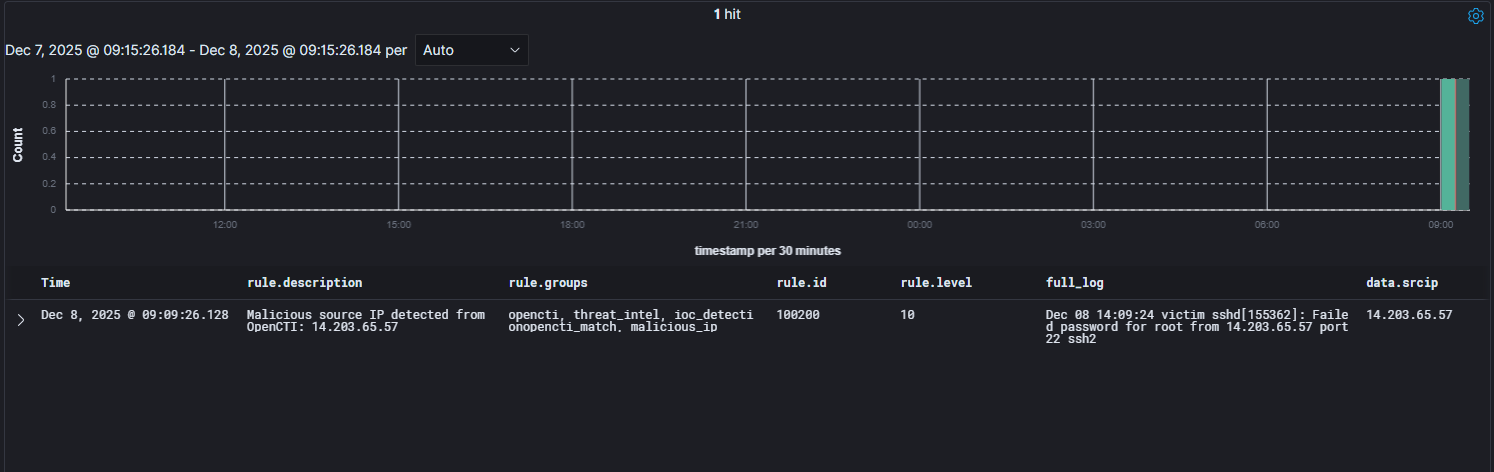
After running the script, here is the alert in Wazuh:
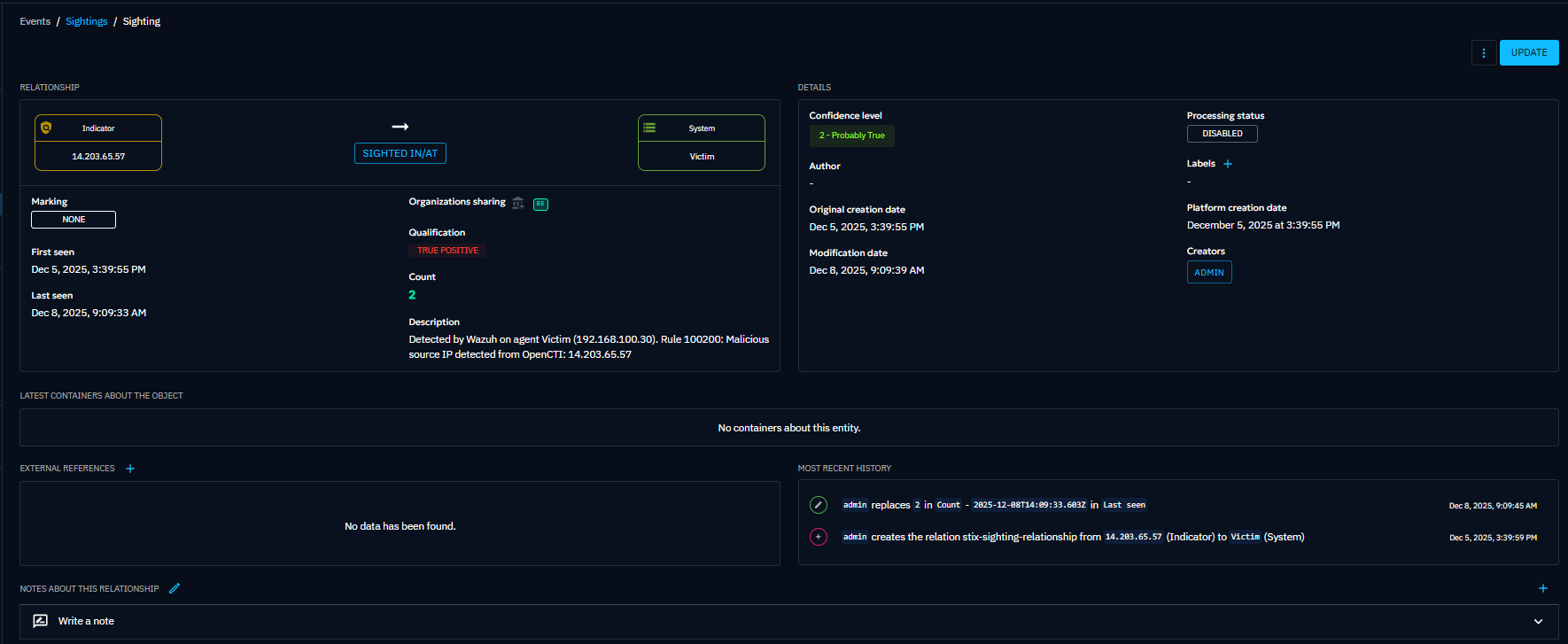
And here is the Sighting in OpenCTI:
Conclusion
Integrating Wazuh with OpenCTI transforms both platforms from independent tools into a cohesive threat intelligence and detection ecosystem. Your SIEM becomes proactive, automatically identifying threats based on global intelligence, while your threat intelligence platform gains visibility into real-world attack patterns in your environment.